Almost everyone my age that I talk with on a regular basis reads xkcd either regularly, or semi-regularly. I also happen to think that most of the people that I talk to on a regular basis are a) intelligent and b) capable of critical thought. Thus, I think I can conclude that there is some merit to xkcd, supposing my claims above are true.
So, for reasons that I cannot determine, I have become fascinated with the website xkcdsucks. I don't know why and I can't stop reading it. Essentially, they complain about every single comic (every single one) and point out some flaws in it. Sometimes their claims are justified, for example this comic is pretty nonsensical, although it still has its charm. But the xkcdsucks post would have you thinking this comic is the worst travesty ever foisted on mankind.
Now of course, no one is forcing me to read their rants, but similarly no one is forcing them to read xkcd (and the forums as they often do), so I'm not too far off complaining about it. In particular, in their search to find something to complain about, they often completely misunderstand the comic. This is not so bad, but it makes me very cranky when opinions are passed off as facts.
As an example, let's take a look at this comic:
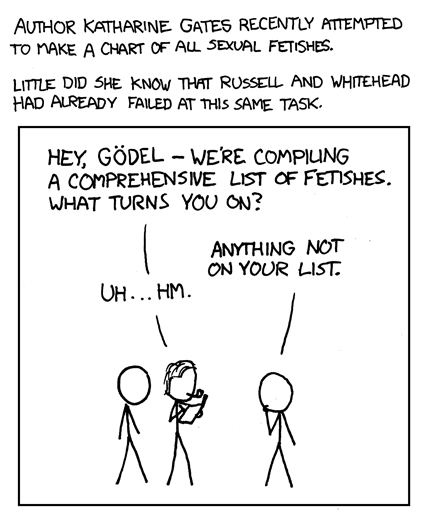 I think this comic is hilarious. Even if you have no idea who Russell, Whitehead and Godel are, I think it's still pretty funny. Now, let's take a look at the xkcdsucks rant about it (the title of which is the best part).
In all fairness, most of the post wasn't written by the regular poster, but it typifies the sorts of arguments used (except that it's more polite).
There are two arguments here. The first starts by attempting to liken this to classical self referential paradoxes like "This statement is false." The author then goes on to state that Godel wasn't the one who came up with lots of contradictions, Russell did. This may be true, and indeed this joke is kind of like the paradox that Russell is known for, but Russel was not the first to come up with these sorts of things, nor was he the last. For example, "this statement is false" comes from Aristotle's works. And certainly Godel did provide a doosie of a paradox, as we'll see shortly
The second argument is that there is no contradiction. The argument works like this: suppose the set of fetishes is finite. Then the answer "everything not on your list" is the same as saying "nothing." But this proof is silly. The comic's Godel says anything not on your list. If there are an infinite amount of things (which their certainly are if we allow for numbers to be things), then there will always be something that is not on the list, no matter how long the list is (unless it is infinitely long, and that's stupid).
So, the mathy criticisms are gone, let me point out why I think this comic is brilliant. Basically, it compresses Godel's incompleteness theorem into one frame. Godel's theorem says: given any sufficiently sophisticated set of basic axioms, there will be a contradiction. The contradiction that will arise is essentially exactly what Godel is saying, that you'll be able to create a statement that says "I am not in your system." This meant that the work that Russell and Whitehead were attempting (a complete acclimatization of mathematics) was impossible without introducing contradictions.
What really made me cranky about the critique was the line that says " And Russell and Whitehead’s Principia Mathematica contains rules explicitly designed to rule out the introduction of such paradoxes" The whole point of Godel's Theorem is that you can't do this.
All in all, my point is thus (and nothing on the internet makes me more cranky than this) if you're going to criticize something, you could at least make sure you're not wrong in a provable way. Having opinions is fine, but don't go making claims that can be shown to be wrong.

No comments:
Post a Comment