01 April 2010

In which I discuss a situation where people are wrong. ON THE INTERNET!


Almost everyone my age that I talk with on a regular basis reads xkcd either regularly, or semi-regularly. I also happen to think that most of the people that I talk to on a regular basis are a) intelligent and b) capable of critical thought. Thus, I think I can conclude that there is some merit to xkcd, supposing my claims above are true.

So, for reasons that I cannot determine, I have become fascinated with the website xkcdsucks. I don't know why and I can't stop reading it. Essentially, they complain about every single comic (every single one) and point out some flaws in it. Sometimes their claims are justified, for example this comic is pretty nonsensical, although it still has its charm. But the xkcdsucks post would have you thinking this comic is the worst travesty ever foisted on mankind.

Now of course, no one is forcing me to read their rants, but similarly no one is forcing them to read xkcd (and the forums as they often do), so I'm not too far off complaining about it. In particular, in their search to find something to complain about, they often completely misunderstand the comic. This is not so bad, but it makes me very cranky when opinions are passed off as facts.

As an example, let's take a look at this comic:
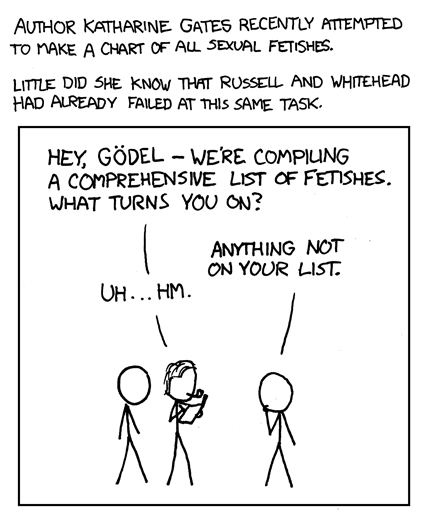
I think this comic is hilarious. Even if you have no idea who Russell, Whitehead and Godel are, I think it's still pretty funny. Now, let's take a look at the xkcdsucks rant about it (the title of which is the best part).

In all fairness, most of the post wasn't written by the regular poster, but it typifies the sorts of arguments used (except that it's more polite).

There are two arguments here. The first starts by attempting to liken this to classical self referential paradoxes like "This statement is false." The author then goes on to state that Godel wasn't the one who came up with lots of contradictions, Russell did. This may be true, and indeed this joke is kind of like the paradox that Russell is known for, but Russel was not the first to come up with these sorts of things, nor was he the last. For example, "this statement is false" comes from Aristotle's works. And certainly Godel did provide a doosie of a paradox, as we'll see shortly

The second argument is that there is no contradiction. The argument works like this: suppose the set of fetishes is finite. Then the answer "everything not on your list" is the same as saying "nothing." But this proof is silly. The comic's Godel says anything not on your list. If there are an infinite amount of things (which their certainly are if we allow for numbers to be things), then there will always be something that is not on the list, no matter how long the list is (unless it is infinitely long, and that's stupid).

So, the mathy criticisms are gone, let me point out why I think this comic is brilliant. Basically, it compresses Godel's incompleteness theorem into one frame. Godel's theorem says: given any sufficiently sophisticated set of basic axioms, there will be a contradiction. The contradiction that will arise is essentially exactly what Godel is saying, that you'll be able to create a statement that says "I am not in your system." This meant that the work that Russell and Whitehead were attempting (a complete acclimatization of mathematics) was impossible without introducing contradictions.

What really made me cranky about the critique was the line that says " And Russell and Whitehead’s Principia Mathematica contains rules explicitly designed to rule out the introduction of such paradoxes" The whole point of Godel's Theorem is that you can't do this.

All in all, my point is thus (and nothing on the internet makes me more cranky than this) if you're going to criticize something, you could at least make sure you're not wrong in a provable way. Having opinions is fine, but don't go making claims that can be shown to be wrong.

24 February 2010

Is Piracy Theft?

I've been on the internet a long time, and it looks like that time has finally come, as it must for every netizen eventually. That time when I must give my thoughts on the problem of Piracy on the web.

I was spurred to do so by the recent Penny Arcade comic and post "A Cyclical Argument With A Literal Strawman". You don't have to read it, the part I am responding to is the underlying assumption that Piracy is an immoral act. Laying aside, for the moment, any arguments which are at their core, "morality is relative, and thusly does not exist." I will broadly allow morality to be a reflection of the core values of our society. So, murdering people is bad (typically, except in war) because as a species we think it is bad. Take whatever you think of as "moral" behaviour and ride along with that.

By piracy, I don't mean stealing a ship and sailing the seas looking for plunder, I mean copying distributing or receiving someone else's intellectual property, without their permission. Broadly speaking, this is theft, and therefore wrong. However, the advent of the digital age changes how piracy works. The OED defines theft as " the felonious taking away of the personal goods of another" (along with some other, irrelevant definitions). If I make a copy of a song, that hasn't directly taken anything away from the artist, so it isn't directly theft. However, under the usual assumptions of our capitalist system, I should pay the artist for their work, at a price they have set. If I do not do this, then I have cost them money.

The entire concept of western capitalism rests on the following idea: for any good, every person values that good some number of dollars. The vendor sells that good for some number of dollars, and if it is being vended for less than or equal to its value, a person will buy it. It is a simple idea we all understand and has served us tolerably well for hundreds of years.

Usually, the vendor selects a price based on 1) guesses about consumer's valuation of the good and 2) how much the good costs to make. But in the digital age, the good costs absolutely nothing to make. Instead, you have your initial cost of creation, and then everything else is profit.

Suppose, for example, I am making a video game. I have 100 employees. It takes them 100 hours each to finish it, and I am paying them $30 per hour. So, I have spent a total of 30x100x100 = $300 000 on making my game. If I sell my game digitally, then I have little to no extra cost per copy sold. Let us suppose that we sell the video game for $30, and we find 200 000 people who value that game as more than $30. Then they will all buy it, and we've made $300 000 in the process.

But suppose there are more people out there who value the game at $5. They wouldn't buy it at $30, but they would at $5. Under the assumptions of the capitalist system, they won't get to play the game (until the price drops low enough after enough time has gone by. Unless the game you made is Starcraft, and it never drops that low). So, we have all these people who would like to play the game, but not enough to pay the full price. Thus, the video game developer would never get any money from them anyways.

The central idea of piracy is to allow these people to play the game. It hasn't cost the developer anything, since they wouldn't have paid anyhow, but more people are able to play the game. One can also assume that occasionally someone who pirates a game will actually buy it if they like it. In this case, what the pirates are doing can hardly be seen as theft, since it takes nothing away from those who hold the copyright. Thus, piracy is not always an immoral action.

That said, many people pirate games/music/videos simply because they can. These people have the means and the ability to purchase the media, but choose instead to download it for free. This is theft, and is morally wrong. The only possible justification is that the entire copyright system is morally bankrupt, and thusly, it cannot be wrong to thwart it. That's a pretty dumb argument though, since firstly two wrongs don't make a right, and secondly, it's pretty hard to say that copyright has no redeeming value.

Content creators aren't dumb, and they know about the first group of pirates, but they care mostly about the second. Those are the ones who are the most vocal, and cause the most damage. I think I can safely say that the content industry cannot hope to prevail against this group. There has never ever to my knowledge been a successful stoppage of piracy. The pirates always get around any protective measures, and they always will.

And here is where we get to what the music industry has finally realized, as will the other industries eventually. Give up. You can't win against the pirates, so stop trying. Instead, offer easy to use, hassle free media with easily circumventable protection. I suspect it would actually boost profits, since you don't have to sink money into protecting your stuff.

The other issue is to address the first group of pirates. The people who want to use what you have, but don't want to pay the full price. Things like student pricing are a good idea, but it could be better. I'm not sure how, but if we could somehow figure out what everyone's valuation of a good was, and offer it to them at that price, maybe you could make even more money. Some kind of barter based system might be effective. The theories of economics that underpin our marketplace are ill suited to the digital world, and I think that instead of trying to change the digital world to fit our theories, we should really be changing our theories to fit with the digital world. After all, that is the point of a theory.

The problem with the whole debate over piracy is that each side accuses the other of immoral behaviour. Each side is justified in what they do, but neither side seems to understand that they're arguing different things. The pirates are arguing that the copyright system is flawed, and the content creators are arguing that piracy is theft. Both and neither are true, and I think it's high time we found a new way of looking at it.

12 December 2008

There's something fishy going on

Today I discovered a very neat horrible invasion of privacy. There is a group on LiveJournal called Project Upstream, which scans livejournal and various other sites (deviantart and such) for AIM screen names, and then randomly starts conversations with each of them, impersonating the other with a screen name that ends with Salmon, Trout or Coho  So, for example I had a conversation that looked like this:

LittleLeagueCoho: Hey.
Me: Hello.
LittleLeagueCoho: To whom am I speaking?
Me: I think it is only fair I know who I am speaking to first.

Whereas the person I was talking to (We'll call them Other) had a conversation that looked like this:


DeclarativeCoho: Hey.
Other: hi?
DeclarativeCoho: Hello.
Other: To whom am I speaking?
DeclarativeCoho: I think it is only fair I know who I am speaking to first.

No one is really sure what is up with this, other than someone wants the world to make friends.  I think this is super awesome, because who doesn't like friends.  On the other hand, I feel slightly violated.  This is basically like a stranger saying, "Haaaaave you met Dan?"  I believe its foundations are in The Great Gatsby, where a central theme is random meetings of people.  So, it fosters friendship and has literary references, which I can certainly stand behind, but is still pretty unsettling.

It turns out that the person I was talking to is pretty awesome.  She went to MIT and is now at Stanford pursuing a Ph.D in applied physics.  But I don't think we'll be friends, simply because I feel fairly inferior to her.  But it was fun.  And now that I know what is going on, I am actually going to talk to people who randomly message me, explain what is going on, and meet interesting people.  If you like, you can get it to randomly pair you with people.

If you'd like to know more about this wacky thing, wikipedia has an article you can read.

Now I feel kind of bad for being a jerk to the first few people this happened to me with.  Maybe they were Ph.D students as well...

24 September 2008

The End of the World

I just thought I'd let everyone know, the world is going to end on December 21, 2012.

It's not going to be nuclear war, or global warming that does it either. No, it will be our nice, friendly Milky Way galaxy that does it.

It all started with the Mayans. They were master mathematicians and astronomers. They could predict solar and lunar eclipses approximately as accurately as we can now. Pretty amazing stuff. Anyways, they had a wonky sort of calendar, which was actually three calendars: a religious calendar, a sun-calendar and a long-count calendar. The religious calendar had 240 days in it, the sun calendar 365 and the long count with 1,872,000 days in it, corresponding to their super keen non-standardized number system, which is almost like base 20, except that they switch it up to other numbers, like 18 or 12 for some digits.

Anyways, clever archaeologists have managed to line up actual dates with the long dates, and have discovered that day 1 of the long date was August 11, 3114 BCE. This places the next day 1 as December 22, 2012. According to Mayan legend, which I am not going to cite, or even give a clue as to how I divined this, the world ends when the current age comes to an end, to be re-born again the following day. This has already happened three or four times, depending on who you ask (the Egyptians thought it was three, the Mayans thought it was four. Both had a long-count-esque sort of calendar).

So, we can definitely see that the world is going to end on December 21, 2012. The question is: how? As it turns out, the same people who are experts in Mayan Prophecy are also experts in Astro-physics. These people are so incredible they can predict, down to the second, when the ecliptic plane will intersect the galactic plane. For the un-initiated, the ecliptic plane is the plane that the planets rotate around the sun on, and the galactic plane is the plane that runs through the centre of the galaxy. Astro-physicists have some various guesses as to where this plane is, but it's pretty hard to nail down exactly, due to the galaxy being quite large, and our instruments being somewhat imperfect. But luckily, the Mayan Scholars have come through for us to inform us that the two planes will intersect at 11:59:59 on December 21, 2012.

Now the question becomes: so what? Well, this one physicist, who is totally legit FYI, thinks that when the two planes intersect, it's going to throw off the balance of gravity in the sun and set off a huge solar flare. This coincides with an event that even mainstream scientists agree with, the 11 year periodic reversal of the sun's magnetic poles. Every 11 years, the sun's magnetic poles flip, causing a spike in solar flare activity. So, we have the sun's polarity flipping and the planes lining up, setting us up for some pretty awesome flares.

BUT THAT'S NOT ALL.

Usually, the earth's magnetic field protects us from such solar flares (although some hefty ones have caused some circuits to fry in the past), but here we're in for another surprise. You see, like the sun, the earth's magnetic field reverses every so often. Could every so often be every 1,872,000 days? It surely could! So, on December 21, 2012, with the help of the planes intersecting, our planet's magnetic poles will flip. Due to some pretty sophisticated science that you probably won't understand (because it is such good science), this will cause the solar flare to become trapped in the earth's atmosphere, frying everything on the surface (us).

In summary, it seems pretty certain that the world is going to end on December 21, 2012. Also, I should add that it is the winter solstice that day, which corresponds to some pagan beliefs about various things which I can't be bothered to explain to someone who isn't one with the earth mother. Also, I'm pretty sure that's the day the LHC is going to perform the experiment to re-create the big bang, so we're pretty much screwed either way. All in all, best to hide in your basement until then.

Note: This post is kind of like a game. A game called "spot the real science." I'll give you a hint: there is very little to find

29 July 2008

Never Forget the Dairy

Today I was looking for some way to organize all of the things I have to get done at work. I usually use Google Calendar for organizing my life, but work poses some problems that Google Calendar can't solve. For example, I often have about 90 ongoing projects to work on, none of which have a set due date. Also, some projects are more important than others and gCal has no way of dealing with that. I do not intend to abandon gCal, but I need something to compliment it. I considered downloading some to-do software or potentially using Outlook's built in features. But I have an additional problem. I alternate between three computers at work, sometimes more. So I will only be able to access my list one third of the time. Obviously that won't work.

I did, however find this fantastic web app called Remember The Milk It is a list-making application it it basically does everything I ever wanted in terms of making a list. Here is a screenshot of the list of things I could remember I had to get done in the near future at work:


Basically, you make a list (in my case, the list I am using is "Work"). You add tasks to the list (with the very obvious "add task" button). Then, you can muddle about with the options, setting higher or lower priority, a due date, how long you think it will take, and whatever else you might want. There's an option there for it.

The best part though, is the ability to tag tasks. It should be stated that I love organizing via tags, and so here I am very happy. It works just the way you might expect it to, and is ever so convenient. The only downside I have found is that you can't make "smart lists" that are automatically generated from a given tag.

I intend to use this app, and I would like other people I know to do so as well. This site ALSO has some social networking features (like the ability to share tasks) so it would be great for collaboratively planning something.

28 July 2008

Blogging

I've decided to start another blog, in the hopes that I will actually update this one. I've decided to use it as a sort of vomitorium of ideas. (A vomitorium, by the way, is exactly what it sounds like.) If I happen to be thinking about something I find interesting, I'll post it here, and that will hopefully allow me to firm up the ideas floating around. There's also on off chance someone else might find it interesting as well.

So, I've decided it's only appropriate to write my first post here about blogging. This is now my fifth blog, despite the fact that if someone asks me I usually say I don't like the idea of blogging. Each of the four previous blogs have been for a different purpose: my first, five years ago, was to test the waters and see what was up this blogging thing everyone kept talking about; my second was a development blog as my roommate and I worked on a programming project that we ultimately abandoned; my third a collaborative blog about the events of my apartment with my roommates and my fourth a travel blog from when I went to China.

And for some reason, even though I was writing all these blogs, for some reason it took me until fairly recently to realize why saying I was opposed to blogs was incredibly silly. Blogs are used for so many things that it's impossible to disqualify them all.

The sort of blog I'm not a big fan of is a personal blog dealing with emotions and relationships, a sort of online, pubic diary. I am a big fan of talking about those things in real life, and I do it all the time. But the problem I have is the public aspect. Putting your innermost thoughts online for the world to see strikes me as a sort of exhibitionism that I find distasteful. Furthermore, I feel voyeuristic reading them, which sort of heightens my aversion.

There is another, related kind of blog that I am not really opposed to, but I have no interest in reading. That is a sort of journal blog, wherein one talks about what things they did that day. I find those interesting only if I don't have regular contact with the person writing them. Otherwise, it becomes too easy to simply read their blog and feel a part of their life, even though you haven't spoken in months. However, if you haven't spoken in months, then it's perfectly alright.

Taking all that into account, I was warring with myself over the tone I wanted to take with this blog. On the one hand, I could keep it strictly professional, writing like I was writing an article on a particular topic. On the other, I could delve into personal stories to illustrate my point. In the end, I chose a balance between the two. I am sharing my own personal opinions (which are not fact, much as I try and convince people otherwise) which will require occasional forays into my personal life. But not very far, and not very specific. The list of the blogs I've had in the past above is probably about as personal as I'm going to go. I intend to never identify any of my friends, or give any details about their lives. All that will be included is enough to explain why I think a certain way.

So, this blog is the ability for me to explain the way I think, if to no one else, then at least to myself. It would be nice if anyone else were reading, but hardly necessary. I've jumped on the web 2.0 bandwagon, and blogging is a huge part of that. It's possible no one will read after this post, but ah well. I don't intend to watch what I say overly much, so I'm likely to say something to offend people. To that, I say tough luck.